|
A Digital Twin (DT) can essentially be characterized as a virtual reflection of a living being and/or its biological/structural possession, a computerized copy that depends on extensive, cumulative, real-time data measurements to imitate any modifications that take place throughout its lifespan. As a result, an evolving digital summary is formed, offering crucial insights regarding its functioning.
The field of agriculture is witnessing a growing utilization of DT technologies in greenhouse cultivation to enhance the supervision of crop production. Every software implementation of a DT necessitates an ontological framework for representing domain knowledge, for instance, the ontology of crop cultivation. Eligibility for Digital Europe: All EU Member State-established legal organizations have the opportunity to take part in the Digital Europe Programme's DT section. The programme offers grants that can cover up to 100% of eligible expenses. The following papers give a short overview about the DT technologies in general: [1], [2], [3], [4], [5], [6], [7]. |
Ontological framework for Digital Twins
Constructing an SKOS (Simple Knowledge Organization System:
[1],
[2])
and an ontology based on OWL2
([1],
[2]) to facilitate effective management of
ancient cereal varieties,
precision solutions in plant protection monitoring,
and animal husbandry.
SKOS was not designed to replace any thesaurus standard but in fact to augment them by bringing the distributed nature of the Semantic Web to thesauri and controlled vocabularies. Toward this end, it was also a design goal of SKOS that it be possible to map any thesaurus standards to SKOS in a fairly straightforward way. Developing a contemporary controlled vocabulary for the fields of smart farming, animal husbandry, and food safety, replacing the previous, outdated versions. Controlled vocabularies provide a cornerstone for linking information on the web. In order for more information sources to integrate, they have to have some common ground. Controlled vocabularies are the best candidate for such common ground. Publishing vocabularies in SKOS allows the concepts they define to be referenced on a global scale. About Semantic Web, these slides could be offered for introduction, online or personal discussion, as needed. |
Acoustic communication
Extensive research has been conducted over the past seven decades to explore the domain of sound-based communication and auditory perception in insects. Studies focused on behavior have highlighted the significance of insect audition for intraspecies acoustic interactions such as attracting mates, engaging in courtship rituals, exhibiting rivalry and territorial behavior, as well as detecting prey, avoiding predators, and locating parasitic hosts.
While vertebrate animals commonly possess hearing and engage in acoustic communication, it is noteworthy that sound production and hearing abilities are widespread exclusively among insects, distinguishing them from other invertebrate groups. A base structure of an evaluation equipment to classify insects could be as follows: 1) attracting insects (electronic McPhail trap), 2) detecting the wings interrupt of infrared light, 3) starting the analog signal recording of wingbeat, 4) evaluation of the recorded signal (FFT - Fast Fourier Transformation), 5) counting the classified insect, 6) sending the counts per/day basis via GSM network to a central data processing server. Papers on acoustic communication in insects: [1], [2], [3], [4], [5], [6], [7], [8]. |
Hydroponics & Aquaponics
Hydroponics vs Aquaponics:
Aquaponics employs a cultivation technique where both fish and plants thrive in a shared environment. On the other hand, hydroponics is a widely recognized and popular plant growth method that exclusively utilizes chemical nutrients and water, enabling plant cultivation without the need for soil. There are six base types of hydroponic systems: 1) Wicking systems The wick system is the most basic type of hydroponic process, also called "the training wheels of the hydroponic world". This kind of growth has actually been used for thousands of years, even before the term "hydroponic" was considered. In a wick system, the nutrients and water are transported to the plants' roots using a wick, like a rope or a piece of felt. The plants are suspended in some sort of growing medium, like coconut coir or perlite. Below the growing tank is a reservoir of water and nutrient solution. One end of the wick is in the solution and the other end of the wick is in the growing media. This allows the wick to transport the water and nutrients at the same rate that the plants' roots require the nutrients. Whenever the roots are ready to absorb, they'll take in the nutrients from the wick. Wick systems are "passive hydroponics" because they don't require air or water pumps. This makes them low-cost and easy to maintain, especially for beginner growers. 2) Deep Water Culture (DWC) Systems The deep water culture (DWC) is the easiest system to maintain for most growers. A DWC consists of a reservoir filled with water and nutrient solution. The plants are suspended over the reservoir using a net pot and growing media. The roots themselves are submerged in the reservoir, so they have a constant supply of water and nutrients. Plant roots need oxygen or they can "drown." Thus, an air pump must be used to pump bubbles in the reservoir to continuously oxygenate the water and deliver necessary oxygen to the roots. 3) Nutrient Film Technique (NFT) Systems The nutrient film technique (NFT) supplies the plans' roots with a thin film of nutrients. The water and nutrient solution is held in a large reservoir, which has an air pump and air stone to stay oxygenated (like a DWC system). However, unlike the submerged roots of a DWC, NFT-system plants are grown in a nearby channel (in net pots). A water pump, set on a timer, pushes water through the channel. This delivers a thin film of nutrients and water to the plants, where the roots are not completely submerged. At the end of the channel, the solution drops back into the main reservoir to be reused in the system. The following figure shows an NFT system's internal block diagram 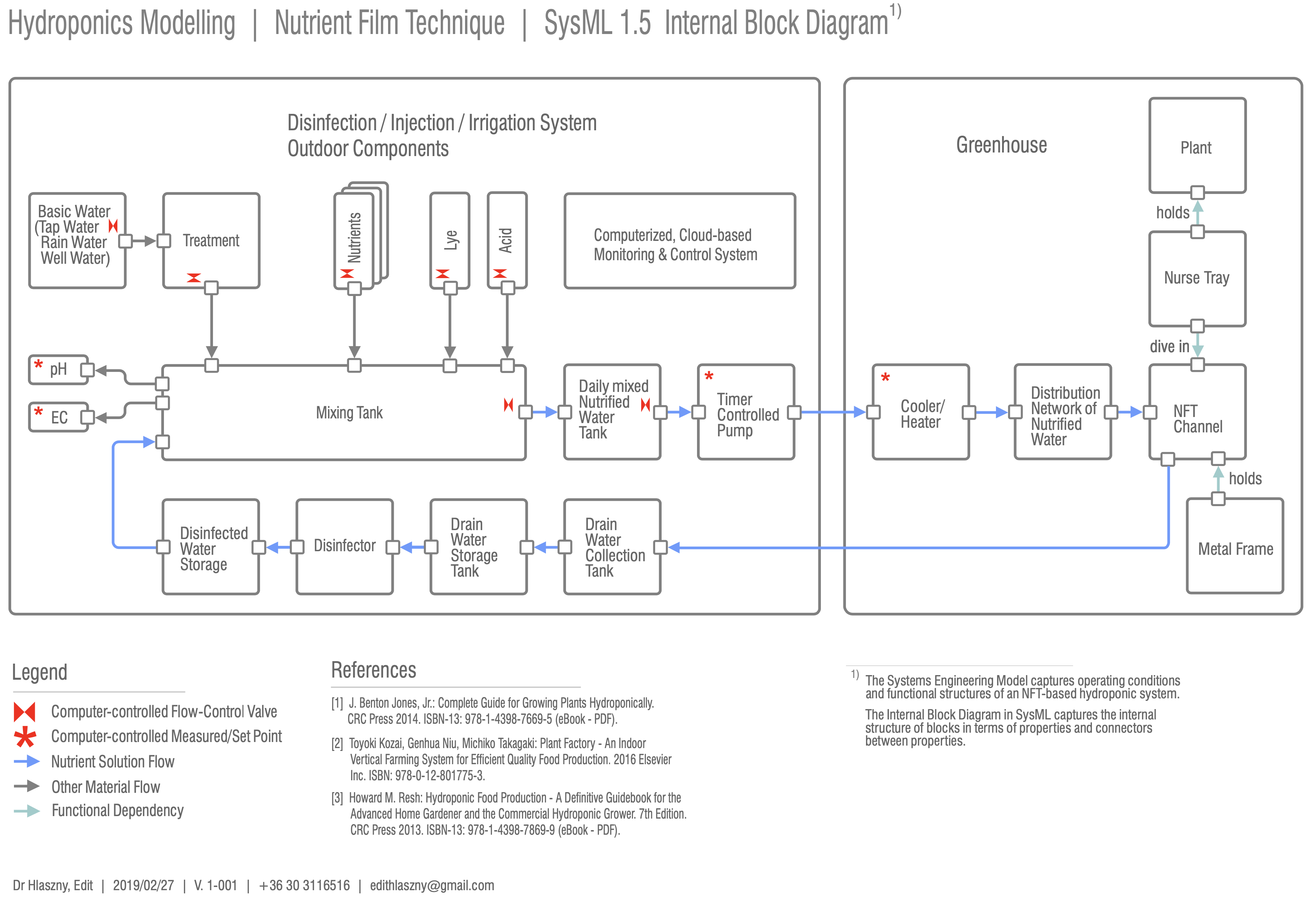
4) "Ebb and flow" Systems An "ebb and flow" system, also called "flood and drain", floods your plants with nutrients on a cycle. This is a less common practice because it's not as flexible to the plants' needs. After flooding the tray, gravity drains the solution back into the reservoir to be reused. An air pump should oxygenate the water in the reservoir as it waits for the next flood cycle. 5) Aeroponics Aeroponic systems are the most high-tech and usually more expensive, but they're also one of the most effective systems. In an aeroponic system, the plants and roots are suspended in air. The reservoir (with oxygenating air pump) has misters, which spray a fine spray over the plant roots. 6) Drip Systems Drip systems are usually found in commercial settings as opposed to residential because they're better implemented on a large scale. These are similar to NFT systems, where the plants are held in a separate channel. The plants are suspended in net pots over a thin layer of water and nutrient solution. A pump continuously moves the water throughout the channel to improve oxygenation and nutrient uptake. Leftover solution flows back into the reservoir to be reused. | Papers and books about hydroponics: [1], [2], [3]. |
Aquaponics is a technology that is part of the broader integrated agri-aquaculture systems discipline which seeks to combine animal and plant culture technologies to confer advantages and conserve nutrients and other biological and economic resources.
Whilst aquaponics broadly combines recirculating fish culture with hydroponic plant production, the application of the term aquaponic is broad and many technologies claim use of the name. Combining fish culture with aquatic-based, terrestrial plant culture via aquaponics may be better defined via its nutrient resource sharing credentials. Aquaponics applies several principles including, but not limited to, efficient water use, efficient nutrient use, lowered or negated environmental impact and the application of biological and ecological approaches to agricultural fish and plant production. The figure below delineates a Recirculatin Aquaculture System's internal block diagram (depicted in SysML 1.5). 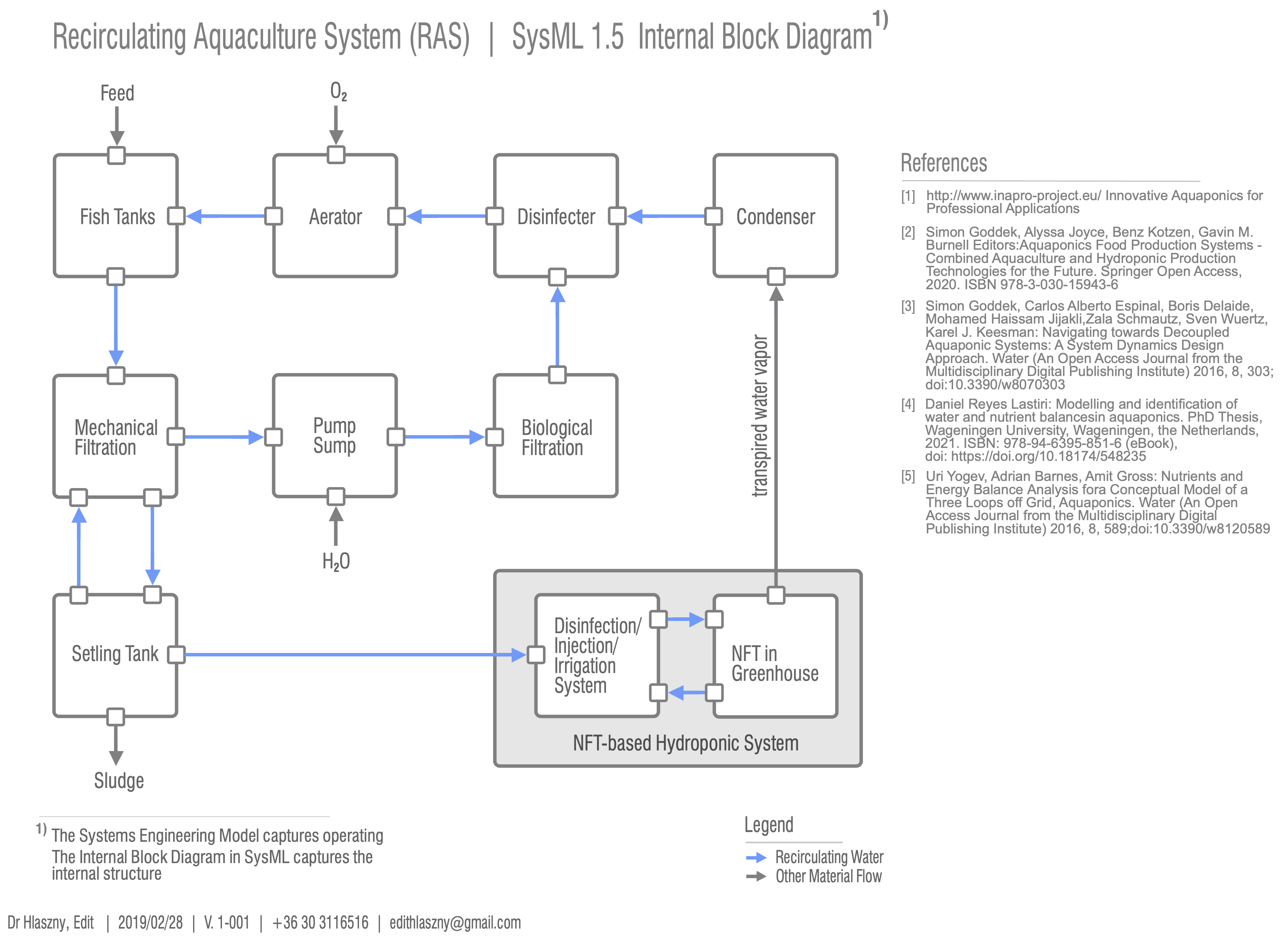
Papers and books about aquaponics: [1], [2], [3], [4]. |
Digital Publishing Solution
Producing and publishing research papers are integral parts of a research institute's core business. This publication activity must be able to handle various electronic formats, enabling the creation of cutting-edge, responsive web pages. Additionally, it should be cost-effective and offer automation support for these technological processes.
Providing a completed XML-based single-styling and single-source publishing solution for WebHelp, PDF, Kindle, EPUB, CHM, InDesign, and plain HTML output, that offers a table of contents, index navigation, search capabilities, and various other features. The WebHelp Responsive system features a very flexible layout and is designed to adapt to any device and screen size to provide an optimal viewing and interaction experience. It is based upon the Bootstrap responsive front-end framework and a template mechanism that allows you to control the position of various functional components in the output to suit your particular requirements. The PDF output is based on an intermediate HTML5 format, very similar to the structure of the HTML pages from the WebHelp system. This means that you can easily customize both types of output at once, using a common CSS file. The publishing solution is grounded on the widely prevalent technology known as DITA. DITA is renowned for its remarkable breadth of usage and is widely embraced across various domains. About DITA, these slides could be offered for introduction, online or personal discussion, as needed. |